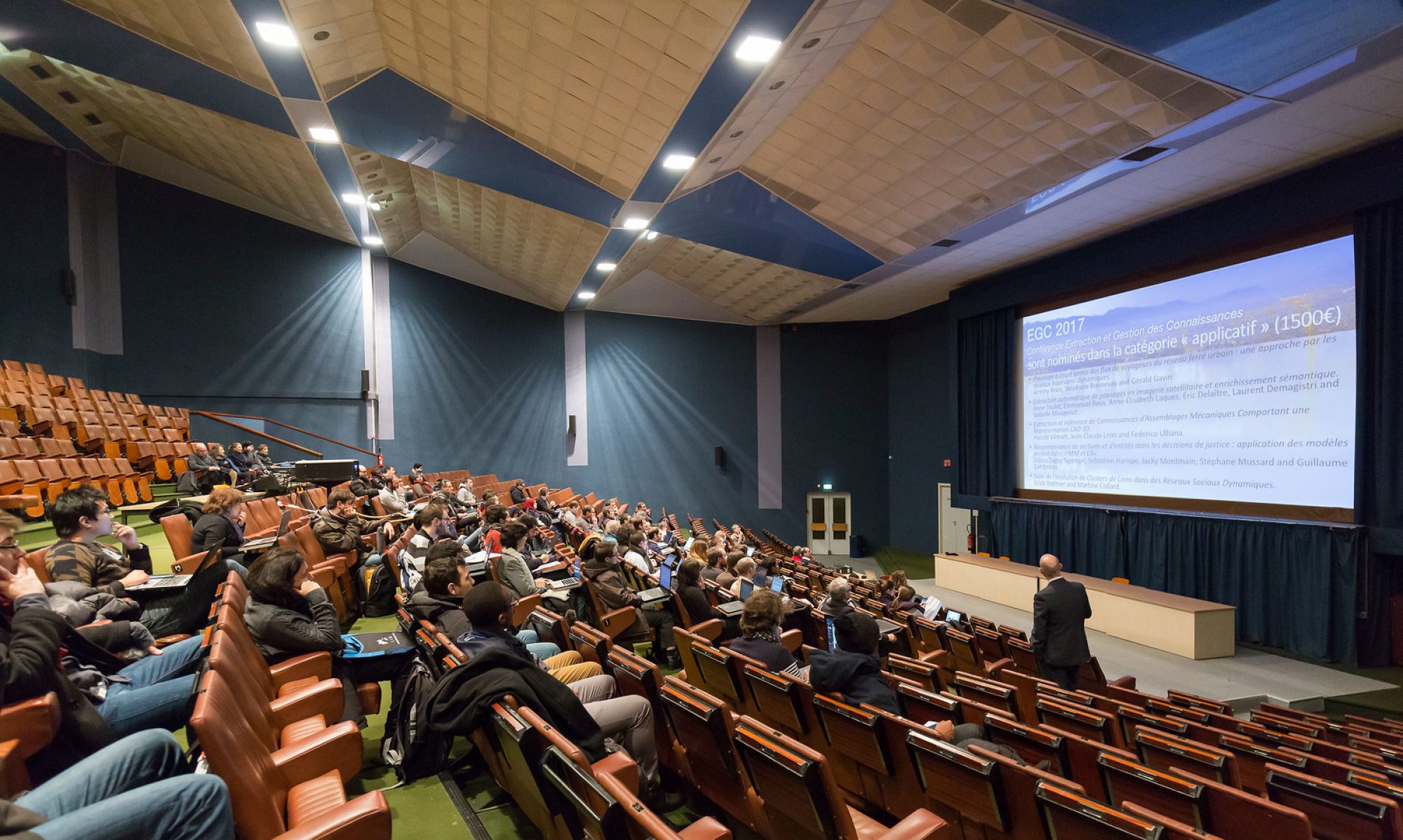

Chantal Reynaud, Arnaud Martin, René Quiniou:
14èmes Journées Francophones Extraction et Gestion des Connaissances, EGC 2014, Rennes, France, 28-32 Janvier, 2014. Revue des Nouvelles Technologies de l’Information E-26, Hermann-Éditions 2014.
Actes Ateliers EGC 2014
Chantal Reynaud, Arnaud Martin, René Quiniou
Site de la conférence EGC 2014
- Vincent Lemaire, Jean-Charles Lamirel, Pascale Cuxac
Clustering and Co-clustering (CluCo)
Pour plus d’informations cliquez ici » - Emmanuel Frenod, Thomas Corpetti, François-Xavier Le Dimet
Couplage des sources d’information hétérogène
Pour plus d’informations cliquez ici » - Cyril de Runz, Cécile Favre, Germain Forestier
Fouille de données Complexes (FDC) - Lydia Boudjeloud-Assala, Bénédicte Le Grand, Rushed Kanawati
Fouille de Grands Graphes (FGG) - Thomas Guyet, René Quiniou, Mathieu Roche, Eric Kergosien
Fouille de données Spatiales et Temporelles/Construction, enrichissement et exploitation de ressources GEOgraphiques pour l’analyse de données (FST/CerGeo) - Hanene Azzag, Fatma Bouali, Fabien Picarougne, Bruno Pinaud, Gilles Venturini
Visualisation d’informations, interactions et fouille de données (VIF)
Pour plus d’informations cliquez ici »
EGC 2013 (Toulouse)
En 2013, deux prix ont été décernés :
- prix EGC-académique :
Claude Pasquier, Jérémy Sanhes, Frédéric Flouvat et Nazha Selmaoui-Folcher.
Extraction de motifs fréquents dans des arbres attribués.
PPME Nouvelle Calédonnie, IBV Nice
Revue des Nouvelles Technologies de l’Information E-24, pages 193-204, 2013. - prix EGC-application :
Bourquard Thomas, Damien de Vienne et Jérôme Azé.
Identification de complexes protéine-protéine par combinaison de classifieurs
BIOS Group INRA Nouzilly, CFR Barcelone, LRI OrsayRevue des Nouvelles Technologies de l’Information E-24, pages 419-430, 2013.
EGC 2013 (Toulouse – France)
 |
|
|
|
||
|
Troisièmes post-actes
Fabrice Guillet, Bruno Pinaud, Gilles Venturini and Djamel Abdelkader Zighed (eds),
« Advances In Knowledge Discovery and Management, Volume 3 »,
Series: Studies in Computational Intelligence,
Vol. 471, 2013, Springer.
ISBN: 978-3-642-25837-4, DOI: 10.1007/978-3-642-35855-5.

About this book
The recent and novel research contributions collected in this book are extended and reworked versions of a selection of the best papers that were originally presented in French at the EGC’2011 Conference held in Brest, France, on January 2011. These 10 best papers have been selected from the 34 papers accepted in long format at the conference. These 34 long papers were themselves the result of a peer and blind review process among the 131 papers initially submitted to the conference in 2011 (acceptance rate of 26% for long papers). This conference was the 11th edition of this event, which takes place each year and which is now successful and well-known in the French-speaking community. This community was structured in 2003 by the
foundation of the International French-speaking EGC society (EGC in French stands for “Extraction et Gestion des Connaissances” and means “Knowledge Discovery and Management”, or KDM). This society organizes every year its main conference (about 200 attendees) but also workshops and other events with the aim of promoting exchanges between researchers and companies concerned with KDM and its applications in business, administration, industry or public organizations. For more details about the EGC society, please consult https://www.egc.asso.fr.
Structure of the Book
This book is a collection of representative and novel works done in Data Mining, Knowledge Discovery, Business Intelligence, Knowledge Engineering and Semantic Web. It is intended to be read by all researchers interested in these fields, including PhD or MSc students, and researchers from public or private laboratories. It concerns both theoretical and practical aspects of KDM.
This book has been structured in two parts. The first part, entitled “Data
Mining, classification and queries”, deals with rule and pattern mining, with topological approaches and with OLAP. Three chapters study rule and pattern mining and concern binary data sets, sequences, and association rules. Chapters related to topological approaches study different distance measures and a new method that learns a hierarchical topological map. Finally, one chapter deals with OLAP and studies the mining of queries logs.
The second part of the book, entitled “Ontology and Semantic”, is more related to knowledge-based and user-centered approaches in KDM. One chapter deals with the enrichment of folksonomies and the three other chapters deal with ontologies.
Written for
Engineers, researchers, and graduate students in computer science
Keywords
Knowledge Discovery, Knowledge Management, Data Mining, Knowledge Engineering, Applications
Table des matières
Part I — Data Mining, Classification and Queries
- Dominique Gay, Marc Boullé:
A Bayesian Criterion for Evaluating the Robustness of Classification
Rules in Binary Data Sets. 3-22 - Julien Rabatel, Sandra Bringay, Pascal Poncelet:
Mining Sequential Patterns: A Context-Aware Approach. 23-42 - Djamel Abdelkader Zighed, Rafik Abdesselam, Ahmed Bounekkar:
Comparison of Proximity Measures: A Topological Approach. 43-58 - Israël César Lerman, Sylvie Guillaume:
Comparing Two Discriminant Probabilistic Interestingness Measures for Association Rules. 59-84 - Hanane Azzag, Mustapha Lebbah:
A New Way for Hierarchical and Topological Clustering. 85-98 - Julien Aligon, Patrick Marcel, Elsa Negre:
Summarizing and Querying Logs of OLAP Queries. 99-124
Part II — Ontology and Semantic
- Freddy Limpens, Fabien Gandon, Michel Buffa:
A Complete Life-Cycle for the Semantic Enrichment of Folksonomies. 127-150 - Ammar Mechouche, Nathalie Abadie, Emeric Prouteau, Sébastien Mustière:
Ontology-Based Formal Specifications for User-Friendly Geospatial Data Discovery. 151-176 - Toader Gherasim, Mounira Harzallah, Giuseppe Berio, Pascale Kuntz:
Methods and Tools for Automatic Construction of Ontologies from Textual Resources: A Framework for Comparison and Its Application. 177-201 - Lionel Chauvin, David Genest, Aymeric Le Dorze, Stéphane Loiseau:
User Centered Cognitive Maps. 203-220
Tutoriels EGC 2013
Christel Vrain, André Péninou et Florence Sèdes
Pour plus d’informations cliquez ici »
- Alexis Bondu, Marc Boullé et Dominique Gay
Les modèles en grilles – Principes, évaluation, algorithmes et applications
Cliquez ici pour télécharger egc2013_tutoriel_Bondu_Boulle_Gay.pdf » - Rokia Missaoui
Fouille dans les réseaux d’information hétérogènes
Cliquez ici pour télécharger egc2013_tutoriel_Missaoui.pdf »
Conférences Invitées EGC 2013
- Fionn Murtagh
Towards a New Science of Big Data Analytics, based on the Geometry and the Topology of Complex, Hierarchic Systems - Rokia Missaoui
Analyse de réseaux sociaux par l’analyse formelle de concepts - Florence d’Alché-Buc
Inférence de réseaux biologiques : un défi pour la fouille de données structurées
Actes Conférence EGC 2013
Christel Vrain, André Péninou, Florence Sèdes:
Extraction et gestion des connaissances (EGC’2013), Actes, 29 janvier – 01 février 2013, Toulouse, France. Revue des Nouvelles Technologies de l’Information RNTI-E-24, Hermann-Éditions 2013, ISBN 978-2-70568-656-7
Actes Ateliers EGC 2013
Christel Vrain, André Péninou et Florence Sèdes
Site de la conférence EGC 2013
- Pascal Cuxac, Jean-Charles Lamirel, Vincent Lemaire et Thomas Guyet
Classifications incrémentales et méthodes de détection de nouveauté (CIDN) - Patrice Bellot, Josiane Mothe, Eric SanJuan et Ludovic Tanguy
Contextualisation de Messages Courts (CMC)
Pour plus d’informations cliquez ici » - Hanene Azzag, Fatma Bouali, Fabien Picarougne et Bruno Pinaud
Visualisation d’informations, interaction et fouille de données (VIF)
Pour plus d’informations cliquez ici » - Guillaume Cleuziou, Cyril de Runz, Germain Forestier, Mustapha Lebbah
Fouille de données complexes : Complexité liée aux données multiples et massives (FDC) - Frédéric Amblard, Cécile Favre et Franck Ravat
Atelier aIde à la Décision à tous les Etages (AIDE)
Pour plus d’informations cliquez ici » - Lydia Boudjeloud-Assala, Rushed Kanawati et Bénédicte Le Grand
Fouille de Grands Graphes (FGG) - Nazha Selmaoui-Folcher, Christophe Rigotti et Frédéric Flouvat
FOuille de données Spatio-Temporelles et Applications (FOSTA)
EGC 2012 (Bordeaux)
En 2012, deux prix ont été décernés :
- prix EGC-académique : ex æquo
- Adriana Prado, Marc Plantevit, Céline Robardet and Jean-François Boulicaut.
Extraction de co-variations entre des propriétés de sommets et leur position topologique dans un graphe attribué. LISIS Lyon
Revue des Nouvelles Technologies de l’Information E-23, pages 267-278 2012. - François Queyroi.
Validation et optimisation d’une décomposition hiérarchique de graphes
LABRI Bordeaux
Revue des Nouvelles Technologies de l’Information E-23, pages 429-440 2012.
- Adriana Prado, Marc Plantevit, Céline Robardet and Jean-François Boulicaut.
- EGC-application :
Christophe Moulin, Christine Largeron, Cécile Barat, Mathias Géry and Christophe Ducottet.
Apprentissage par analyse linéaire discriminante des paramètres de fusion pour la recherche d’information multimédia texte-image
LHC Saint-Etienne
Revue des Nouvelles Technologies de l’Information E-23, pages 357-368 2012.